How Long Should a Bridge Transfer Take?
Most cross-chain transfers complete in 1 to 20 minutes. Some canonical bridges take longer - up to a few hours - and optimistic-rollup withdrawals can take up to 7 days by design. The time your transfer takes has almost nothing to do with "network traffic" in the way people usually mean it. It comes down to three things:
-
How long the source chain takes to finalize your transaction
-
Which security model the bridge uses
-
How fast the destination chain can process the incoming deposit
If you're staring at a spinner right now wondering whether something's wrong, skip to what to do when it doesn't arrive. If you want to understand why the estimate you were quoted is the estimate you got, keep reading.
Why Transfer Time Varies
A bridge transfer isn't one action - it's a relay race with three legs, and your total time is the sum of all three. Let’s take a closer look at each part of the race.
1. Source-chain finality
Before a bridge will act on your transaction, the source chain needs to consider it irreversible. This is the single biggest lever on total time, and it varies enormously by chain:
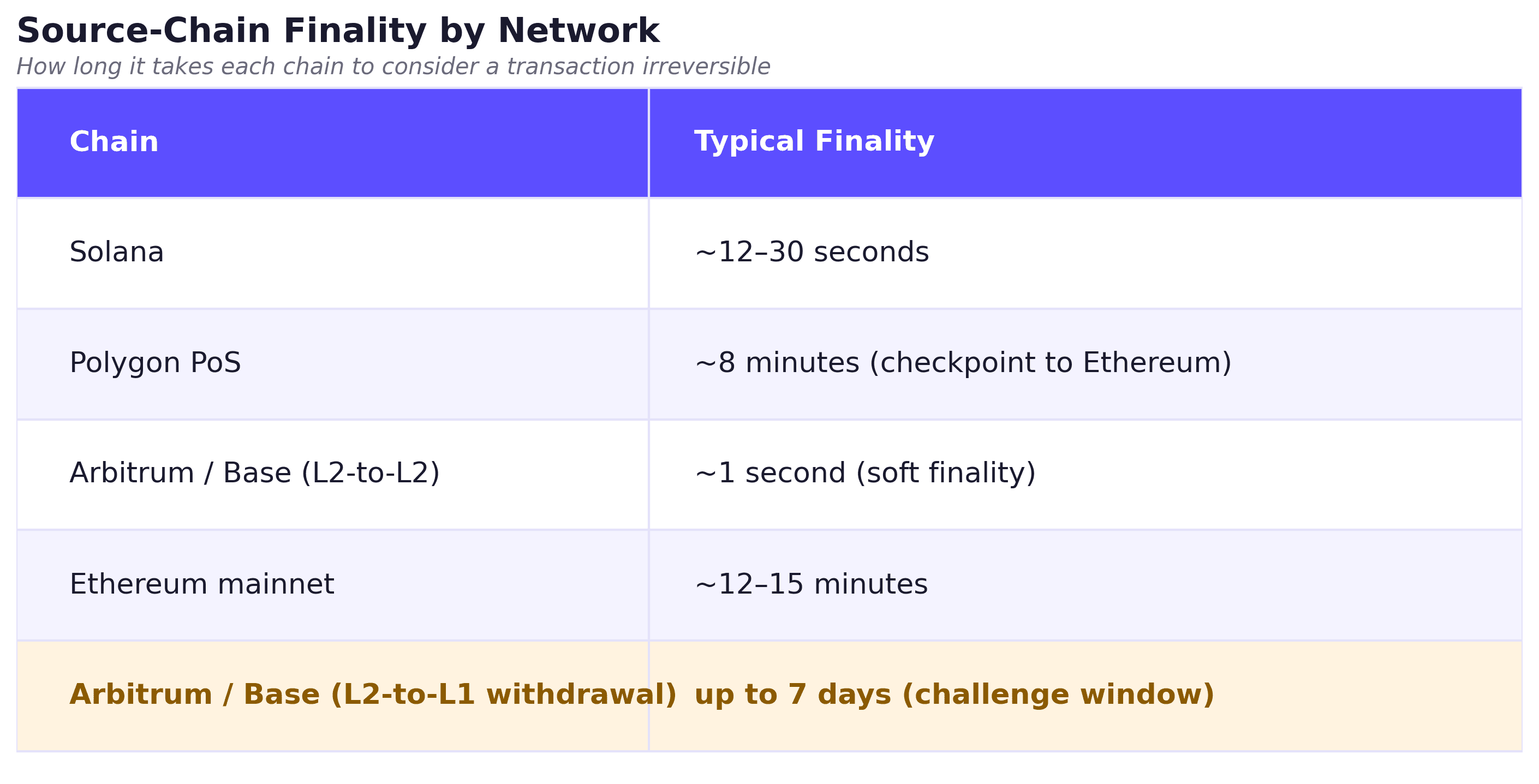
Notice that L2s are fast for L2-to-L2 movement but slow for withdrawals back to L1 - that's not a bug, it's the security tradeoff optimistic rollups make. More on that below.
2. The bridge's security model
Broadly, there are two families:
-
Canonical / lock-and-mint bridges wait for full source-chain finality before minting on the destination. Slower, but you're relying on the underlying chains' security rather than a third party's judgment. We've covered how lock-and-mint actually works here.
-
Intent / liquidity-network bridges skip the wait by having a relayer front you the destination funds immediately, then reconcile with the source chain in the background. Faster - often under a minute - but you're now trusting the relayer's solvency and the reconciliation process.
Neither is "better" in the abstract. It's a speed-versus-trust-assumption tradeoff, and it's worth knowing which one your transfer is using, because it explains the number you were quoted.
3. Destination-chain processing
Even a bridge that fills instantly still has to land in the next available block on the destination chain, and a congested destination chain adds real delay here - this is the one piece that does fluctuate with "network traffic."
The Realistic Time Bands
Rather than ranking specific bridges against each other (speed benchmarks shift constantly and a table of named providers goes stale in a quarter), here's a rough breakdown by category:
-
Intent-based / same-ecosystem transfers: seconds to a couple of minutes
-
L2-to-L2 canonical bridging: roughly 10-20 minutes
-
Ethereum-origin canonical bridging: roughly 15-30 minutes
-
Optimistic rollup withdrawals (L2 → L1): up to 7 days - this is the one that catches people off guard, because it's not a malfunction, it's the challenge window that makes the withdrawal trust-minimized in the first place
If you were quoted something in the first three bands and it's taking noticeably longer, that's worth investigating. If you're doing an L2 withdrawal and it says "7 days," that's the system working as intended, not stuck.
What to Do When a Transfer Is Stuck
If you bridged using CoW Swap's cross-chain swaps feature, here's what's actually happening under the hood, and what to check at each stage.
First, check the order status in CoW Explorer. Every cross-chain swap has two tabs - Swap and Bridge - so you can see exactly which leg you're waiting on. If it says "Bridging in progress," the swap already completed and you're waiting on the bridge provider. If you don't see a bridge status at all yet, the swap itself hasn't executed - nothing has been sent anywhere, and your funds are still in your wallet.
Know that the bridge only starts after the swap succeeds. These aren't parallel processes. If your order expired, got canceled, or failed at the swap stage, bridging never began - there's nothing to track because nothing left your wallet. This trips people up more than actual bridge delays do.
The estimated bridging time you saw at quote time came from the bridge provider, not from CoW Swap. It's a live pass-through number, not a fixed promise, so some drift is normal - particularly during the source-chain finality window described above.
If the bridge deposit fails or expires, your funds don't vanish - they route back to your Account Proxy (also called CoW Shed), a personal contract that acts as a safety net for exactly this scenario. Expiration windows are set by the bridge provider, not CoW Swap or CoW Protocol.
A quick example: Across typically refunds after around 3 hours if a deposit hasn't completed. Once a refund lands in your Account Proxy, you can recover it from the Account Proxy page in your CoW Swap account by selecting the relevant proxy version and withdrawing the token to your wallet.
One thing you can't do: once the swap has executed and the bridge deposit has been submitted, the transfer can't be manually canceled from your side. At that point it will either complete on the destination chain or refund per the provider's policy - there's no in-between action to take except wait or check the explorer.
When to actually be concerned: if you're well past the quoted estimate and past the provider's stated refund/expiry window and CoW Explorer shows no status change, that's the point to reach out for support with your order ID in hand.
Quick Answers
Why is my bridge transfer taking longer than expected?
Usually one of three reasons: the source chain hasn't reached finality yet, the bridge you're using is a canonical (not intent-based) bridge that waits for that finality by design, or the destination chain is congested. None of these mean the transfer failed.
Is a slow transfer a sign something's gone wrong?
Not by itself. Check whether you're within the bridge provider's stated time range and refund window before assuming a problem. A transfer that's merely slow behaves very differently from one that's actually failed - the latter typically resolves via an automatic refund, not silence.
What's the longest a bridge transfer should normally take?
For standard deposits, a few hours at the outside. The major exception is optimistic rollup withdrawals back to L1, which have a built-in challenge period that can run up to 7 days - that's a deliberate security feature, not a delay.